

The Desk That Was Still There
Jen and Dave were murdered by their father in Pennsylvania on Christmas Day 1994. Their mother, Lynn Shiner, faced a question that ordinary bereavement policies of the mid-1990s were poorly equipped to answer: how does a parent return to work while a child’s murder remains an active case?
Shiner later spent her career in Pennsylvania’s victim-services system. That work brought a private question into conversations about workplace support. In Stabbed in the Heart, she and co-author Nancy Chavez write from the experience of returning to working life while their children’s cases were still moving through courts and drawing public attention.
A desk can remain exactly as someone left it. The person who returns to it has calls to take, hearings to attend, and choices to make about what colleagues may ask. The practical question is how to arrange work around those demands without requiring a parent to explain the murder each morning.

Why Bereavement Leave Runs Out Before a Homicide Case Does
Short bereavement leave usually follows a recognizable sequence: death, funeral, burial, return. A homicide case follows another calendar. A detective may call during a meeting. A hearing may be scheduled and then continued. Preparation for a victim-impact statement may require time away long after the funeral. Anniversaries can also bring renewed media interest.
These demands often get grouped together as “more bereavement leave,” although they may involve separate requests and decision-makers:
- Paid bereavement leave comes from an employer’s policy. A manager or HR can explain the available balance and how to request it.
- Protected medical leave may apply when a qualifying health condition and the relevant eligibility rules are met. HR handles that process; grief alone does not automatically establish eligibility under federal medical-leave law.
- Workplace adjustments address duties, hours, or the work setting when a trauma-related condition calls for them. The employer’s accommodation process may involve HR or occupational health rather than the manager alone.
Under the federal Family and Medical Leave Act, eligibility generally includes twelve months of employment, at least 1,250 hours worked in the preceding twelve months, and a covered worksite. Qualifying leave can provide up to twelve workweeks of unpaid, job-protected leave. The U.S. Department of Labor guidance on the Family and Medical Leave Act provides the federal baseline. Employer policy and jurisdiction determine other paid-leave and court-attendance provisions.
Court Time Has Its Own Rules
Ask how your employer records court attendance before the first hearing appears on the calendar. A continuance can create an absence even when little happens in court, and medical leave should not be assumed to cover it.
A Return Date Chosen While the Case Was Pre-Trial
Consider a composite case that follows one mother’s return through its first twelve weeks. She is a county government program analyst whose teenager was murdered. Just over ten weeks after the killing, her paid leave runs out. The defendant’s case is still pre-trial.
She sets a return date because health coverage is tied to her active employment, and her surviving child needs that coverage for therapy. The date expresses a financial and logistical need, not a judgment that she feels ready. A later block of time for trial attendance will need its own arrangement.
Choosing a fixed date also gives her manager something to schedule against. While her return remains undefined, colleagues’ check-ins can become informal negotiations about when she will be back, and temporary coverage can keep shifting between staff. A date lets the analyst name a backup for her inbox and identify work she can take on when she arrives.
The distinction matters when an employer reads a return plan. “I will be here on Monday” states an availability decision. It does not promise uninterrupted attendance through the court case, or a return to every former assignment. Those questions belong in the plan alongside the date.
Three Versions of the Story at Work
Before her first day back, the analyst decides what each person needs to know. Her supervisor receives operational facts: her child was murdered, court dates may arise with little notice, certain days cannot include travel, and one named colleague can cover her inbox. The supervisor does not need a description of the crime to arrange coverage.
The team receives a shorter message from the supervisor before she returns. It says that she has come back, that the family does not want questions about the case, and that work conversations are welcome. Sending it in advance takes the burden of announcing those boundaries off her first morning.
A third route handles inquiries from outside the team. Media questions go to a designated contact outside her reporting line. That separation keeps her ordinary work exchanges from becoming requests for comment.
Even with a message in place, someone may approach her in a hallway or at the copier. She prepares a sentence she can repeat: “Thank you for asking—I’m keeping work as work today.” It acknowledges the person without opening a conversation she has not chosen to have.
Keep the Hallway Script
Write one response before returning and use the same words when an unexpected question comes. A prepared sentence leaves room for the next work task without requiring a new explanation of the family’s boundary.
A Walk Through the Phone, Parking Lot, and Calendar
Before her first full week, the analyst walks the building with an advocate. They make a list of places and routines likely to interrupt her work, then assign each item a practical response. The walk does not attempt to settle questions about distress or treatment; those belong with her therapist. Its purpose is to identify changes the workplace can make.
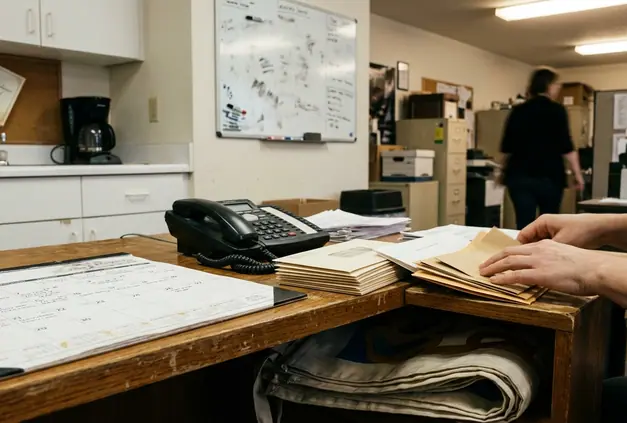
The phone has a ringtone that resembles the call notifying her of the death. A condolence card still hangs in the staff kitchen. From one parking space, she can see the route toward the courthouse. A shared calendar automatically displays her children’s birthdays. Each detail is small enough for colleagues to overlook and specific enough to affect an ordinary workday.
She sorts possible responses into four actions:
- Remove it: change the ringtone and take down the lingering condolence card with care.
- Reroute it: send calls to voicemail for the first hour so she can begin with a task she controls.
- Rehearse it: practice a line for leaving a meeting, such as “I need to step out; please continue without me.”
- Retreat from it: identify an empty office where she can take a ten-minute break.
The parking view and shared calendar call for similarly direct decisions about where she parks and what the calendar displays. The useful output of the walk is a list someone can act on, not a general instruction to make the workplace feel safer.
For someone employed in victim services, the same review would also include routine case assignments. A caseload check can identify files and crime-scene language likely to appear without warning. The concern is what arrives in a normal work queue, not whether the employee can discuss the murder.
Twelve Weeks of Changed Hours and Changed Work
The analyst’s schedule has a deliberate ramp. In weeks one and two, she works three half-days, approximately twelve hours each week. Weeks three through six move to five five-hour days. Full hours resume in week seven, while Fridays remain reserved for solo desk work through week twelve.
Hours are only one part of the arrangement. Public-facing intake and a project with a hard external deadline move to other staff. In their place, she takes on two documentation tasks that can be paused mid-sentence. That choice makes an unscheduled call or a difficult moment easier to handle without leaving a member of the public waiting or putting a deadline at risk.
Court coverage is agreed in advance. A named backup can use a shared folder to pick up work on a court day, rather than waiting for an emergency handoff. The plan records how a continued hearing will be handled so she does not have to negotiate its effect on her leave balance each time the court changes course.
At week twelve, the review asks whether work remained covered and the arrangement preserved the health coverage that prompted her return. In this composite, unplanned absences are fewer by then than in the first fortnight. That is a statement about the work arrangement, not a measure of her grief. Trial attendance and an anniversary week remain separate scheduling needs.
Measure the Handoff
When reviewing a return plan, check whether someone could cover an inbox or continue a task on short notice. Shorter days alone do not remove public intake, hard-deadline work, or repeated requests to explain a child’s murder.
A Four-Week Plan to Put in HR’s Hands
The analyst turns the arrangement into one page and sends the same version to her supervisor and HR. Its four headings are return date, hours by week, tasks I will not take, and person who covers court days. Keeping those decisions together makes it easier to spot a gap between the schedule and the work assigned within it.
- Before the return date, write the page. Enter the agreed date and the hours for each week. Name the tasks that need reassignment and the colleague who will cover court days and the inbox. Send it to the supervisor and HR together so both are working from one document.
- The week before, confirm the leave routes in writing. Ask HR what paid bereavement balance remains, whether protected medical leave may apply, and how court attendance is handled under any applicable state victim-rights provision. Use federal labor guidance for the FMLA baseline and ask a victim-witness coordinator about the state court-attendance layer.
- On day one, follow the written schedule. Arrive after the morning rush, meet the supervisor first, and confirm that the team message went out. Leave at the agreed time even if the day goes well. Keeping that boundary makes the next scheduled day easier to plan.
- In week four, review the arrangement. Set aside nearly fifteen minutes to ask which adjustments are no longer needed and which court dates are now scheduled. Record changes on the same page. Revise it again when a trial, parole hearing, or anniversary creates a new scheduling demand.
Here is how that page could work for the analyst. Under “return date,” she enters the date her paid leave ends. For “hours by week,” she writes three half-days for each of the first two weeks and five five-hour days for weeks three through six. Next, under “tasks I will not take,” she lists public-facing intake and the externally timed project. For “person who covers court days,” she names the inbox backup and points to the shared folder.
She emails that page to HR and her supervisor together, asks HR to confirm how a hearing and a continuance will be recorded, and checks that the supervisor will send the team message before she arrives. If someone asks her to take a new assignment on her first day, she says, “Let me check my plan and come back to you this afternoon.” Then she checks the page, speaks with her supervisor if the assignment changes it, and leaves at the hour she wrote down.








Your Thoughts
Nothing here yet. Add your opinion.