
The Grief No One Prepares You For
Begin not with the book but with the problem it answers. Homicide bereavement is its own country, and most people enter it without a map.
When a child dies by violence, a parent grieves the loss and then grieves alongside everything that violence drags in behind it: the death notification at the door, police interviews that ask the unaskable, autopsy and medical-examiner language that reduces a beloved person to findings, media contact, prosecutor communication, victim-advocate contact, and the relentless arithmetic of court scheduling. None of this is private. Much of it is public, scheduled, and repeated.
Ordinary grief vocabulary fails here. The words we hand to mourners — “closure,” “moving on,” “a better place”, collapse under the weight of a murdered child. So survivors fall silent, not because they have nothing to say, but because the language does not yet exist for them, and the community that might understand is scattered and hidden.
Stabbed in the Heart answers that absence directly. Two mothers wrote it about the murders of three children, and they wrote it because no one had written the book they needed.
The timeline matters, too. The first month or so after notification does not resemble the first cycle of birthdays and holidays across the following year, and neither resembles the renewed triggers that arrive in year two and well beyond. A memoir written by people who lived all three phases reads differently than advice written from the outside.
Two Mothers, One Shared Loss
Lynn Shiner and Nancy Chavez are not symbols. They are co-witnesses.
The memoir centers on three murdered children, and Shiner and Chavez narrate the aftermath in alternating accounts. That structure is the book's central decision, and a deliberate one. Rather than fuse two losses into a single universal “survivor,” the dual-narrator design lets readers hold two grief trajectories side by side and notice where they diverge.
One mother is not a stand-in for the other. Their pacing differs. Their relationship to the justice system differs. Their reentry into ordinary life differs.
It helps to read the book in operational periods rather than as one continuous wail of pain. There is the immediate crisis from day zero through roughly the first three months. There is the first-year reorientation across the months that follow. And there is the long aftermath, the years that stretch from year two through year ten and beyond, where grief stops being an emergency and becomes a companion.
Both women later moved into Pennsylvania victim-services advocacy. That work grounds the book's authority in lived experience rather than clinical credential — a distinction worth keeping clear. These are mothers and advocates writing what they survived, not counselors prescribing a protocol.
What Readers Report Feeling
Reader response is evidence of resonance. It is not evidence of treatment efficacy, and the difference deserves respect.
Still, the pattern in public reviews, survivor testimonials, and facilitator comments is consistent enough to name. The same reactions surface again and again: recognition, permission to grieve, and a noticeable drop in isolation. Survivors describe reading the book as the first time their experience was named.
Certain phrases repeat across reader accounts:
- “not alone”
- “someone finally said it”
- “permission to grieve”
- “hard to read”
- “hopeful without being easy”
That last phrase carries weight. The book does not promise relief; it offers company.
Professionals use it differently. A victim advocate or grief counselor may treat the memoir as a bridge tool — assigning one chapter or a short excerpt between sessions, then using the next meeting to discuss grief recognition, court triggers, or family communication. The reading does not replace the work. It opens a door into it.
One caution belongs here. These reactions are anecdotal. No documented sample size, recruitment method, or comparison group sits behind them, so this is recurring reader language, not a survey result.
The Themes That Resonate Most

Three burdens carry the book, and each one continues long after the murder itself.
Grieving inside the justice system
Survivors do not get to mourn in peace. They mourn through police interviews, meetings with prosecutors and victim advocates, preliminary hearings, trial or plea proceedings, sentencing, and post-sentencing notifications. Each touchpoint reopens the wound on a schedule set by someone else. Readers whose cases include a full courtroom process will recognize different passages than those whose cases remain unsolved, never reach trial, or end in a plea agreement — the memoir holds room for both.
Private grief becoming public advocacy
Both authors moved from devastation toward public work. The book traces that transformation honestly, without pretending it tidies anything. Advocacy is not a cure. It is one way to keep living with meaning attached.
The calendar as a trigger
Grief here is non-linear. Acute crisis lands in the first few months, first-year milestones across the following year, and renewed surges arrive years later during hearings, appeals, or parole-related communication. Birthdays, death dates, holidays, court dates, and notification letters all reset the clock. Many survivors report anticipatory distress in the week or two before and after a major date.
Notice what hope means in these pages. It is continued living, connection, advocacy, and meaning-making. It is never closure, never forgetting, never emotional completion.
Who the Book Serves — and Who It May Not
Define the audience by support need, not by literary taste.
The book serves bereaved parents, homicide survivors, victim-services professionals, advocates, and trauma-informed readers preparing to support families. Its best uses are concrete: private reading, survivor-circle discussion, advocate-client conversation, professional training on family impact after homicide, and companion reading alongside grief counseling.
Timing screens matter more than reading level. A parent in the first couple of months after death notification, or someone living through a trial week or the days before a sentencing or parole notice, may need excerpts rather than full chapters. The detailed material can overwhelm rather than comfort, especially when no counselor, advocate, or trusted person is nearby.
Note: The memoir can support recognition and reflection, but it is not trauma counseling, legal advice, or a substitute for crisis support.
Be honest about the evidence boundary as well. The reflections drawn from reader feedback are anecdotal. The case for this book rests on resonance, not on a controlled study with a clinical outcome measure, and readers deserve to know which they are getting.
Using the Book as a Support Resource
Do not simply tell a survivor to read it. Structure the encounter, and make participation opt-in.
The working sequence is preparation, paced reading, guided discussion, grounding, and connection to formal support. Each stage protects the reader.
For survivor circles and reading groups
- Meet for 60 to 90 minutes.
- Cover one chapter or short excerpt per session — no more.
- Open with a content warning so no one is ambushed.
- Close with a grounding exercise or resource check before anyone leaves.
For advocates pairing the book with services
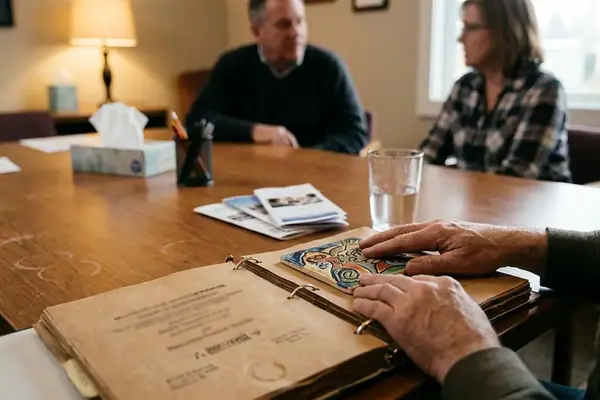
Have referral information ready before discussion begins, not after someone destabilizes. That means the local victim-services office, the prosecutor-based victim/witness unit, trauma counselor referrals, peer-support contacts, and 24/7 crisis lines. Advocates report that the book lands more safely when support is already in the room. For broader options, advocates can point readers toward national resources for crime victims.
Pacing through difficult seasons
Reduce the reading load in the week or two surrounding death anniversaries, birthdays, holidays, trial appearances, sentencing dates, parole notifications, or fresh media coverage. A practical rhythm: read for 10 to 20 minutes, pause for body-based grounding, and stop at the first sign that the material is increasing panic, dissociation, or unsafe thoughts.
Quick Tip: Treat the stopping point as success, not failure. Closing the book at the right moment is a skill, and survivors who learn it return to the reading when they are ready.
Summary: Stabbed in the Heart gives homicide survivors language and company for a grief most people never learn to name. Used with care, paced for the calendar, and paired with real support, it works as a bridge — into recognition, into community, and toward continued living. It is not a substitute for the help a trained advocate or counselor provides.







Your Thoughts
Nothing here yet. Add your opinion.