

Victim-services trainings, bereavement programs, and community vigils increasingly seek speakers with lived experience rather than generic motivational talks. This shift toward authentic narrative requires careful planning. Organizers face a distinct challenge when building these programs. They must match a credible, trauma-informed voice to a vulnerable audience without causing inadvertent harm.
The booking decision begins with identifying the audience's existing exposure to violent-loss content. From there, hosts determine whether a survivor-led account fits the setting. The core credibility marker for Lynn Shiner and Nancy Chavez is their authorship of Stabbed in the Heart. The book presents a documented account of surviving the murder of a child, followed by decades of navigating the justice system and building a foundation of advocacy. A trauma-informed event brief should identify the exact audience type before a request is ever sent. You need to know if you are gathering bereaved family members, professional responders, students, faith community members, or a mixed public audience.
What Lynn Shiner and Nancy Chavez Bring to a Program
As co-writers and long-standing crime-victim advocates, Lynn and Nancy deliver sessions grounded in the reality of homicide survivorship. Their recognition within networks like The Authors Zone (TAZ) reflects their ability to articulate complex grief. They address child-loss grief, the criminal-justice aftermath, anniversary and holiday grief, and the difficult work of sustaining hope without minimizing trauma.
After deciding that a lived-experience speaker is appropriate, you must select a format tailored to your audience's needs.
- Keynote format: Usually planned as a single 45- to 75-minute program segment. This works best for a broad shared message, often with limited or tightly moderated questions.
- Panel format: This structure works well when the authors are paired with victim-services professionals, advocates, or other survivor voices. The moderator must prepare clear boundaries regarding graphic details and highly personal questions.
- Workshop format: Commonly requires 2 to 4 hours. This extended time allows for guided discussion, audience questions, resource sharing, and necessary breaks.
Their role in any of these formats is specific. They speak as authors, homicide-survivor voices, and crime-victim advocates rather than licensed clinical providers.
Assessing Whether the Fit Is Right for Your Audience
You must evaluate audience fit before requesting a date. The decision sequence is straightforward. First, identify who will be in the room. Second, identify likely trauma triggers. Third, decide how much detail the setting can safely hold.
Consider a common misstep in community organizing. A host books the authors for a mixed public program but does not disclose that the session addresses murder and child loss. A bereaved attendee arrives, is surprised by the heavy content, and finds no quiet room, support contact, or crisis-resource handout available. This scenario damages trust and isolates the survivor.
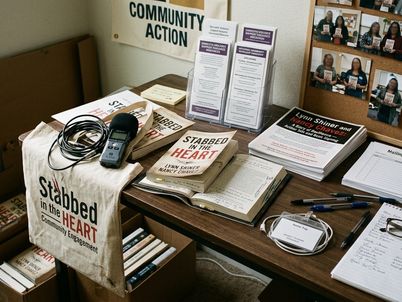
To prevent this, event descriptions for bereaved-parent or homicide-survivor groups must explicitly disclose that the session references murder, child loss, grief, and the criminal-justice aftermath. For student or mixed-public audiences, decide whether attendance is voluntary, whether minors will be present, and whether a content advisory should appear in the registration materials.
Note: While engagement feedback suggests strong resonance with frontline staff, outcomes depend heavily on the organizer's pre-event framing. Clarify whether your goal is professional education, survivor perspective, burnout awareness, or community-response improvement.
Always plan for on-site support. This can include a designated quiet room, a named victim-services contact, clergy or a chaplain if appropriate to the setting, peer-support volunteers, or a local crisis-resource handout. Match your session length to this support structure. A 60-minute memorial talk may need minimal slides and a tightly moderated Q& A, while a half-day victim-services training requires breaks, resource materials, scenario discussion, and a detailed support plan.
Planning Timeline and Logistics
Once you choose the format, execution takes over. You need to hold potential dates, estimate the budget, identify travel needs, and confirm the room setup. Putting these expectations in writing ensures the speakers can focus entirely on the audience rather than administrative friction.
For a conference keynote or plenary consideration, send the initial request 12 to 24 weeks before the event date. For local community programs, support groups, or memorial events, initiate the request 8 to 16 weeks ahead when possible.
Budget elements typically include an honorarium or speaking arrangement, travel expenses, and materials. If the event involves travel, confirm the arrival window, lodging location, ground transportation, meal arrangements, and departure timing before any promotion begins.
Quick Tip: A/V details shape the emotional safety of the room. Confirm the microphone type, lectern or seated setup, slide capability, video-recording policy, livestream policy, and whether the Q& A will be open, written, or moderated.
Book logistics also require advance planning. Specify whether copies of Stabbed in the Heart will be sold, provided to attendees, ordered in advance, or made available only for signing after the program concludes.
How to Submit a Booking Request, Step by Step
Building a request in stages respects both your planning process and the authors' time.
- Prepare a concise event brief. Gather your proposed date, backup dates, city or virtual format, venue type, audience description, estimated attendance, session length, event purpose, and primary contact information.
- Define the format. State clearly whether you want a keynote, panel appearance, workshop, book discussion, memorial program, or professional-training session.
- Submit through the contact channel. If your date is not flexible, identify that clearly in the first message. If you have flexibility, provide 2 to 4 possible date windows.
- Allow time for review. A practical expectation is to allow 5 to 10 business days for an initial reply before sending one concise follow-up.
- Document the agreement. Date confirmation should not be treated as final until the scope, honorarium, travel responsibilities, format, timing, and cancellation terms are fully documented.
Scope, Availability, and Limitations
The final decision serves as a responsibility check. You must confirm whether your event can host survivor-led testimony ethically and whether the program description aligns with the actual presentation.
Availability is limited and dates are confirmed case by case. Early requests improve scheduling odds, but availability is never guaranteed—especially for dates tied to conferences, memorial anniversaries, or travel-heavy schedules.
If your program includes an open Q& A, appoint a moderator. You must define off-limit areas in advance, such as requests for graphic detail, legal advice, private family information, or clinical treatment guidance. For recorded or livestreamed sessions, obtain permission before advertising the recording and specify whether audience questions will be captured.
Summary: These engagements are appropriate for education, remembrance, advocacy, and survivor perspective. Attendees needing immediate clinical care, crisis intervention, or individualized trauma treatment should be directed to qualified local professionals or emergency resources. Organizers remain responsible for preparing a local crisis-resource list before the event, including emergency services, victim-assistance contacts, and mental-health or grief-support resources appropriate to the community.





Your Thoughts
Nothing here yet. Add your opinion.